Our graduate-level economics tutors teach elasticity from a range of textbooks to MBA students from a range of B-school courses. So we tutor elasticity and related concepts from different angles. Here is a brief look at the various aspects of elasticity.
Elasticity in economics captures how one economic variable responds to changes in another. Or, in other words, elasticity captures how sensitive one variable is to changes in another variable.
MBA and CFA students most frequently encounter price elasticity in the introductory economics classes. Price elasticity measures how a change in price, an increase or a decrease, will affect the quantity demanded (an increase or decrease). You will encounter other types of elasticity later.
As mentioned earlier, elasticity in economics captures how one economic variable responds to changes in another. Elasticity of variables commonly studied by economists includes price, income, price of substitutes, price of complements, expenditure, etc. When the elasticity variable is not specified, it is assumed that one is talking about the price elasticity of demand.
Price Elasticity of Demand
Elasticity, or more specifically, price elasticity of demand, measures the change in quantity demanded in response to a change in the price of that good, holding other factors constant. Managers often want to understand how the demand for a product will change if the price of that product or service changes.
Cross Price Elasticity
Price of substitutes, price of complements, competitors’ prices, etc., affect the demand for a product. Managers often want to understand how the demand for a product will change if the price of a related good changes. This metric is defined as cross-price elasticity. Cross price elasticity measures the change in quantity demanded of a product given a change in a related good. The related good can be a complement or a substitute or a competing good.
Income Elasticity
Income elasticity is another commonly used type of elasticity. Income elasticity measures the change in quantity demanded as a result of a change in income, holding other factors constant.
Long Run Elasticity vs Short Run Elasticity
Each of the elasticities discussed above can also be categorized as long-term elasticity and short-term elasticity. Long-term elasticity and short-term elasticity are referred to as long-run elasticity and short-run elasticities. Long-run elasticity and short-run elasticities are different because the time taken for the market participants to make changes to their consumption patterns quickly varies by product. So some products will see a change in consumption quickly and others take longer. We will cover long-run elasticity and short-run elasticity later in this article.
Elasticity of Demand vs. Elasticity of Supply
Elasticity can be measured not only for the demand curve. Elasticity can be measured for the supply curve as well. Similar to the price elasticity of demand, the price elasticity of supply measures the change in quantity supplied in response to a change in the price of that good, holding other factors constant. While MBAs and CFAs typically deal with the elasticity of demand more often, economists also study the elasticity of supply. Economists and managers will want to understand how the supply of a product will change if the price of that product or service changes.
The elasticity of demand is represented by the Greek letter epsilon (ε). The elasticity of supply is represented by the Greek letter eta (η).
How is Elasticity Measured In Economics?
Measuring elasticity is frightfully simple. The percentage change in quantity demanded by a percentage change in price gives the price elasticity coefficient Ep (called price elasticity):
Elasticity (price) = % change in quantity
% change in price
The percentage change in quantity is arrived at by dividing the unit change in quantity due to the price change by the total quantity before the price change. The percentage change in price is calculated by dividing the dollar change in price by the initial price.
What is the Unit of Elasticity in Economics?
Elasticity is a ratio of two numbers and is therefore a unitless measure. This makes it possible to compare and contrast elasticity of different products or the same product across countries or over time.
Measures of Elasticity: Point Elasticity vs. Arc Elasticity
There are two ways to measure elasticity: point elasticity and arc elasticity. While the concept and objective is the same, the process and formula differ. We discuss review both point elasticity and arc elasticity below.
Point Elasticity
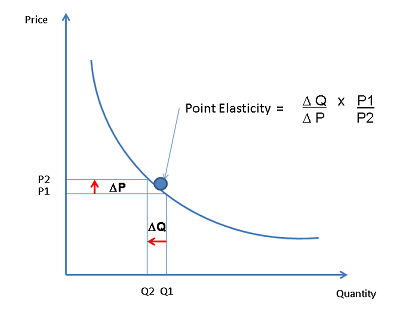
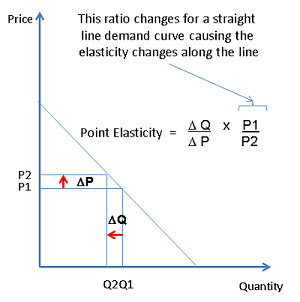
Point elasticity is the price elasticity of demand at a certain point on the demand curve. Point elasticity captures the change in quantity when the price changes by an infinitesimally small change at a point on the demand curve. The elasticity at this point on the demand curve, according to the formula, is: Ep = ∆Q/∆P x P1/Q1.
When the price increases by a small amount at P1 spot in the demand curve (between P1 & P2), we see that the quantity demanded decreases from Q1 to Q2.
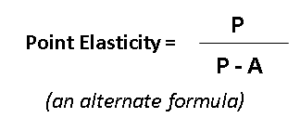
An Alternate Formula for Point Elasticity
There is an alternate formula for computing point elasticity. This formula is the mathematical equivalent of the above point elasticity formula and so will result in the same point elasticity value. This can be used in both linear and curvilinear demand functions. P stands for price in both the linear and curvilinear demand functions. However, A stands for the price intercept in the linear demand function, BUT A stands for the intercept of the tangent of the point of interest in the curvilinear demand function.
Arc(h) Elasticity
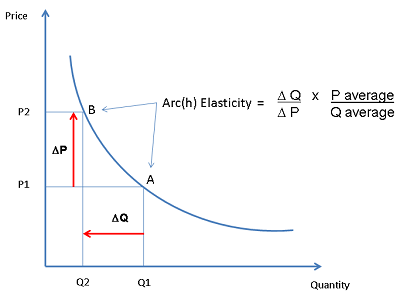
Arch elasticity would be point elasticity …….. shown over a whole range of prices. Arch elasticity is the elasticity between two points on the demand curve. It shows the elasticity over a stretch of the curve. If you are considering the elasticity between the points A and B, which are further apart from each other, unlike in the previous diagram, we would call it arc elasticity to acknowledge the arc distance between points A and B. Arc elasticity is found by taking the average of the two prices and the average of the two quantities.
Degrees of Elasticity – Elastic, Inelastic or Unitary elastic
Elasticity offers valuable insights into the relationship between the price and quantity of a product. Look at the absolute value of elasticity indicated by │Ep│. The absolute value of elasticity is elasticity without the negative sign.
Elastic Demand
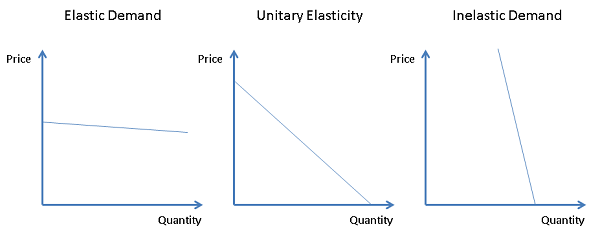
If │ Ep│>1, then demand is said to be elastic. When demand is elastic, a percentage increase (decrease) in price leads to a larger percentage decrease (increase) in quantity demanded. Perfectly elastic demand would be a flat demand curve, indicating that a small change in price leads to a complete drop-off in demand. When we say elastic, it usually means a relatively elastic demand curve where a change in price has a larger change (not a complete drop off) in demand.
Inelastic Demand
If │ Ep│<1, then demand is said to be inelastic. When demand is said to be inelastic, a percentage increase (decrease) in price leads to a lower percentage decrease (increase) in quantity demanded. Perfectly inelastic demand would be a vertical demand curve, indicating that any change in price does not lead to a change in demand. When we say inelastic, it usually means a relatively inelastic demand curve where a change in price has a small change (as opposed to no change) in demand.
Unitary Elasticity
If │ Ep│=1, the demand is said to be unitary elastic. When demand is said to be unitary, a percentage increase (decrease) in price leads to exactly the same percentage decrease (increase) in quantity demanded.
Elasticity and How can you Increase Revenues?
Understanding elasticity can help managers understand the impact of price changes on the revenues of a company because elasticity measures the relationship between quantity demanded and price. These two variables, quantity demanded and price, determine revenues:
Revenues = Quantity Demanded * Price
When price increases (decreases), we know the quantity demanded for a normal good decreases (increases). How would revenues change when one of the two variables decreases and the other increases or vice versa? The total impact on revenue would depend on whether the price impact or the quantity impact is more powerful. Understanding elasticity can answer this question:
Will my revenues go up or down if I increase prices?
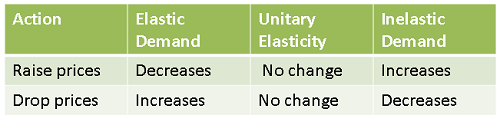
When the demand curve is elastic, an increase in the price causes the quantity impact (decrease in demand for a normal good) to be more powerful than the price impact, leading to a drop in revenues. Similarly, when the demand curve is elastic, a decrease in the price causes the quantity impact to be more powerful (increase in demand for a normal good) than the price impact, causing an increase in revenues.
When the demand curve is inelastic, an increase in the price causes the quantity impact to be less powerful than the price impact, leading to an increase in revenues. Similarly, a decrease in the price causes the quantity impact to be less powerful than the price impact, leading to a decrease in revenues.
When the demand curve is unitary elastic, a change in the price causes the quantity impact to be equal to the price impact leading to no change in revenues.
Is Elasticity Different in the Short-Run vs. Long-Run?
Elasticity of a product varies over time. Economists categorize time into short-run and long-run time frames. The elasticity of a product varies over time frames because elasticity is a property of demand curves. And the demand curves of a product look different when different time periods are considered.
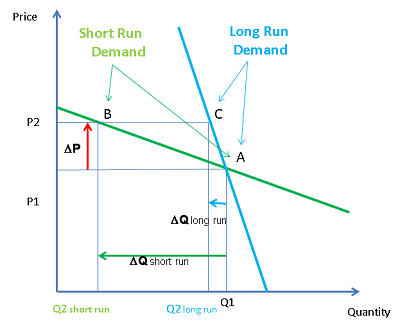
The time frame over which elasticity is measured is important to understand and distinguish. The consumption or demand for some products can more easily be changed in the short run. In contrast, the consumption or demand for some products takes longer to change in response to a change in price. For example, if Dominos were to increase the price of pizzas, people could easily switch to buying pizzas from a competitor. However, people can’t immediately switch to electric cars because the price of fuel has increased. Consumers have to evaluate electric cars, plan to finance and pay for the electric car, etc. before a change can be made. If the price of fuel stays high for a longer period, the demand for electric cars will increase as people can plan and buy electric cars. This nature or property of the demand curve for electric cars is captured by looking at the short-term cross-price elasticity and long-term cross-price elasticity perspectives.
What Constitutes Short-Term and What Constitutes Long-Term in Economics?
What constitutes short-term and what constitutes long-term depends on the product. What constitutes short-term and what constitutes long-term depends on the time period in which customers can fully adjust their purchase decisions or adapt to price changes. Therefore, the short-term period may be weeks for a product like pizza, but the short-term period may be months or years for a product like gasoline cars.
The nature of the product, consumption patterns, durability, etc, determines if demand is more price elastic in the long run than in the short run. For some goods (like coffee, gasoline, etc.), demand is more price elastic in the long run than in the short run because it takes time to change purchase and consumption patterns. For some goods (like cars, TVs, etc.), the demand is more price elastic in the short run than in the long run because consumers can delay purchases in the short run by extending the life of the product, but because the life of these products cannot be indefinitely extended, elasticity is not elastic in the long run.
Is Elasticity Constant in a Linear Demand Curve?
On a linear demand curve (straight line), elasticity will change at all the points on the curve. A constant slope would ensure that the elasticity would be anything but constant, because the percentage change and ratio of price and quantity would be different, given the changes in the numerator and denominator base values.
Is Elasticity Constant in a Curvilinear Demand Curve?
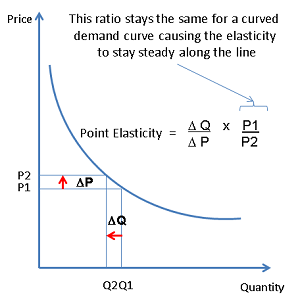
When the demand is curved, elasticity could be constant as the percentage changes adjust. This insight is purely a mathematical one, and our graduate economics tutors will be happy to walk you through this with a numerical example.
What are the Factors that Affect Elasticity?
Why does our demand for certain goods change dramatically and why does it not change for some products? The reasons are pretty simple, but they do make an impact on whether we want to buy or not at various price points.
The Actual Nature of the Product
If the product is a necessity for me, then I will buy the product no matter what the price is. So essential goods like food grains, vegetables, and especially medicines will be on my shopping list no matter the price because I absolutely cannot do without them. I may reduce the quantity if the price goes through the roof, but then again…..that’s a maybe. So the demand for these goods are more inelastic in nature.
When the product is a comfort good to me, like a high-end TV or gourmet ice cream, something that improves my well-being but is not an absolute necessity, I would look at the price and buy it if I think it’s reasonable, or maybe leave it for a time when I think it will be. The demand for these goods is generally more elastic in nature.
A quick note must be added that a necessity or luxury need not be the same for all consumers.
Income Levels of Consumers
Products whose consumers have high incomes usually have lower elasticities, as high-income consumers are not inclined to cut down consumption or expenditure owing to a small change in prices. However, products with consumers with low incomes typically exhibit lower elasticities because low-income consumers have to budget expenses carefully. Therefore, the sensitivity of demand to changes in price will also be a function of the income levels in the market.
The Availability Substitutes
Another factor that significantly affects is availability of substitutes or alternative options. I go back to the very easy-to-understand option of fast food. If my fried chicken is looking pricey, I hop over to pizza or vice versa. The more options I have available at my fingertips for a certain type of product, and the closer the substitutes are in nature, for example, Pepsi and Coke; the more elastic its demand is bound to be.
Market Elasticity vs. Brand Elasticity
Here, there must also be a mention of market elasticity versus brand elasticity. Sometimes the market elasticity of a product as a whole, for example, cigarettes, is relatively inelastic due to the addictive nature of the product. If, however, the price of one brand goes up, consumers tend to drop that brand and switch to the cheaper ones. So, while you see the market is inelastic, the demand for each brand of cigarettes is elastic.
Possibility of Postponement of Consumption.
If I can put away the use of a particular product, then its demand would be highly elastic (at least in the short term), as I can postpone the purchase of the good easily. For example, I can defer the purchase of a car or a washing machine if the price has risen. This would not be the case for toothpaste or a lifesaving drug. Demand for these products is inelastic.
Number of Uses
Let us take the example of electricity. I use electricity for many things, but if bills get high, I try to use it only for essentials. So I would do the dishes after dinner and give the dishwasher a rest. I would cut down on the air conditioning and switch to fans when the weather became cooler. The demand for electricity is elastic, against a product which had only a specific use, or maybe a few specific uses. Therefore, the more uses for a product, the more elastic its demand.
Share of Wallet
If a large chunk of my income is spent on a particular product, then the product’s demand will be elastic, because I will spend considerable time and effort mitigating expenses when the price increases. For example, the demand for a car will be elastic as it is a major expenditure for an average family. An item that accounts for a small portion of my monthly budget will have inelastic demand, as I don’t bother with an increase in prices. For example, the price variations in the price of a needle or a matchbox are not going to affect the demand.
Time period
Short periods of time induce little or no elasticity. Over a longer period, demand is more elastic because consumers take time to explore options, change habits, and adjust to price increases.
Habit
Goods that have become a habit or maybe even an addiction swing over to the list of necessities and hence become inelastic in their demand. Alcohol, tobacco, coffee, and cigarettes fall into this category. No matter what the level of scarcity or price rise the demand is not likely to be altered.
Income Elasticity And Type Of Good (Normal vs. Inferior)
Income elasticity helps you classify a product or service as a normal good versus an inferior good. If a product’s income elasticity of demand is positive, the product is considered a normal good. A positive income elasticity of demand indicates that the higher the income, the more the demand for the product, which fits the definition of a normal good.
If a product’s income elasticity of demand is negative, the product is considered an inferior good. A negative income elasticity of demand indicates that the higher the income, the lower the demand for the product will be, which fits the definition of an inferior good.
Elasticity Indicates Who Pays the Taxes, Levies, and Cost increases.
Understanding the elasticity of demand and supply reveals critical insights into who bears the cost of new taxes, levies, or other input cost increases. When a new tax or levy is introduced, the producer would like to pass it on to the consumer as an additional cost. However, the consumer would like the producer to eat the cost! Who ends up eating the new tax or levy depends on who has more ‘leverage or power’ in the relationship. The elasticity of demand and the elasticity of supply reveal who has more ‘leverage or power’ in the relationship. The more elastic the demand curve is relative to the supply curve, the consumers or buyers have more leverage or power in the relationship.
The % of tax paid by consumers
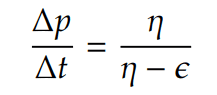
When a new tax or levy or a cost increase occurs, the cost increase borne by the consumer is reflected in the price increase. If the price does not increase, it means the cost is borne by the producers. If the price increase is equal to the new tax, it means that the consumer is paying the full tax. Often, some portion of the tax is paid by the producer, and the consumer pays the remaining. The percentage of tax or cost increase borne by the consumer is ∆P/∆t and reflected by the formula on the right.
The % of tax paid by producers
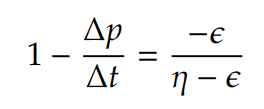
Here, ∆P reflects the percentage change in price, and ∆t reflects the change in taxes. Epsilon (ε) is the elasticity of demand, and eta (η) is the elasticity of supply. Note that elasticity of demand (ε) is a negative number and elasticity of supply (η) is a positive number.
The percentage of tax or cost increase borne by the producer is 1-(∆P/∆t) and reflected by this formula on the left.
Elasticity and Optimal Pricing or Markups
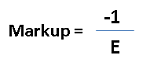
Pricing a product is a significant challenge for managers. Elasticity of the product plays an important role in the pricing of a product. For example, if you are a monopolist, you will maximize your profit when your markup on your product is the inverse of your product’s elasticity.
Different market conditions, different elasticity, and different elasticity-pricing rules. For example, in a perfectly competitive market, you cannot decide your product’s price because your elasticity is zero or perfectly inelastic. If you increase your price, your sales will drop to zero reflecting a perfectly elastic setting. Here is a writeup on the difference between a shift of the demand curve vs. movement along the demand curve.
Understanding Elasticity with Tutoring
Elasticity is a topic every single MBA student will encounter in economics. It is a beautiful and multidimensional concept with applications across disciplines, including finance, marketing, pricing, and strategy. As it is a multidimensional topic, there are many ways to look at elasticity. This often confuses students or hinders a full understanding of elasticity. In fact many text books cover only some of these perspectives on elasticity.